Vector and Matrix Calculus
Table of Contents
| Scalar Field | Vector Field | |
|---|---|---|
| 0th Derivative | 𝑓 | 𝐟 |
| 1st Derivative | 𝛁𝑓 | 𝐉 ⊃ 𝛁∙𝐟, 𝛁×𝐟 |
| 2nd Derivative | 𝐇 ⊃ 𝛻²𝑓 |
- The \(\nabla\cdot\) and \(\nabla\times\) is the formal product. So the regular rule for dot product and cross product may not apply.
- \(\nabla\) is not compatible with dot and cross product, that is, \( \mathbf{v}\cdot (\nabla \mathbf{w}) \neq (\mathbf{v}\cdot \nabla) \mathbf{w}. \)
1. Gradient
- Vector field that represents the rate of change in a space.
1.1. Definition
- For a morphism \(f\colon X\to Y\), the gradient \(\nabla f\colon X\to Z\) is a linear map, such that \[ dy = \langle \nabla f, dx\rangle \] in which bilinear map \(\langle \cdot, \cdot \rangle\colon Z\times X \to Y\) is well-defined.
1.1.1. Orthogonal Curvilinear Coordinate System
- \[ \nabla f = \frac{1}{h_i}\frac{\partial f}{\partial x^i} \mathbf{e}_i \]
- where \[ h_i = \left\| \frac{\partial \mathbf{r}}{\partial \tilde{x}^i}\right\|. \]
1.2. Properties
- This can also be written in terms of differential form as: \[ dy = df(dx). \]
1.3. Formulae
2. Divergence
2.1. Definition
- Divergence of a vector field \(\mathbf{F}\) is \[ \nabla\cdot \mathbf{F} = \frac{\partial F_{x_i}}{\partial {x_i}}. \]
2.1.1. Orthogonal Curvilinear Coordinate System
- \[ \nabla\cdot \mathbf{F} = \frac{1}{\prod_j h_j}\left(\frac{\partial}{\partial x^i}\prod_{j\neq i}h_jF^i\right) \] where \[ h_i = \left\| \frac{\partial \mathbf{r}}{\partial \tilde{x}^i}\right\|. \]
2.2. Interpretation
- The net flux through a unit volume.
- The rate of change of the ratio of volume (the ratio of the rate of
change in volume, rate of change of a unit volume) subjected to the
flow of a vector field.
- For a vector field given by a linear transformation:
- \[ \nabla\cdot(\mathbf{Ax}) = \frac{d}{dt}\ln V \]
- The infinitesimal transformation generated by the vector field
\(\mathbf{F}\) is:
\[
\tilde{x}^i = x^i + F^idt
\]
- The Jacobian of the transformation would be: \[ J_i^j = \begin{bmatrix} 1 + \partial_{x^1}F^1dt & \partial_{x^2}F^1dt & \cdots & \partial_{x^n}F^1dt \\ \partial_{x^1}F^2dt & 1 + \partial_{x^2}F^2dt & \cdots & \partial_{x^n}F^1dt \\ \vdots & \vdots & \ddots & \vdots \\ \partial_{x^1}F^ndt & \partial_{x^2}F^ndt & \cdots & 1+ \partial_{x^n}F^ndt \\ \end{bmatrix} \]
- And the determinant is: \[ \det J_i^j = 1 + \nabla\cdot \mathbf{F}\,dt + O(dt^2) \]
- By taking the derivative of that: \[ \frac{d}{dt} \det J_i^j = \nabla\cdot \mathbf{F} \]
- For a vector field given by a linear transformation:
3. Curl
3.1. Generalization
3.1.1. Orthogonal Curvilinear Coordinate System
- \[ \nabla\times \mathbf{F} = \frac{1}{h_1h_2h_3}\begin{vmatrix} h_1\tilde{\mathbf{e}}_1 & h_2\tilde{\mathbf{e}}_2 & h_3\tilde{\mathbf{e}}_3 \\[.5em] \dfrac{\partial}{\partial \tilde{x}^1} & \dfrac{\partial}{\partial \tilde{x}^2} & \dfrac{\partial}{\partial \tilde{x}^3} \\[1em] h_1\tilde{F}^1 & h_2\tilde{F}^2 & h_3\tilde{F}^3 \\ \end{vmatrix} \]
- where \[ h_i = \left\| \frac{\partial \mathbf{r}}{\partial \tilde{x}^i}\right\|. \]
3.1.2. General Coordinate System
- \[
(\nabla \times \mathbf{F} )^k = \frac{1}{\sqrt{g}} \varepsilon^{k\ell m} (\nabla_\ell \mathbf{F})_m
\]
- using the covariant derivative.
- By the symmetry of the Christoffel symbols , \[ (\nabla \times \mathbf{F} ) = \frac{1}{\sqrt{g}} \mathbf{e}_k\varepsilon^{k\ell m} \partial_\ell F_m \]
3.1.3. Differential Form
- \[ \left(\star(\mathrm{d}\mathbf{F}^\flat)\right)^\sharp \]
- where \(\flat\) and \(\sharp\) are the musical isomorphisms that takes the basis vectors into corresponding basis 1-forms.
3.2. Matrix Expression
When cross product is expressed as matrix, curl is twice the antisymmetric part of the Jacobian: \[ \vb{J} - \vb{J}^{\mathsf{T}} = [\curl{\vb{F}}]_{\times} = \begin{bmatrix} 0 & - \partial_{[x} F_{y]} & \partial_{[z} F_{x]} \\ \partial_{[x}F_{y]} & 0 & -\partial_{[y} F_{z]} \\ -\partial_{[z} F_{x]} & \partial_{[y} F_{z]} & 0 \end{bmatrix} \]
4. Laplacian
4.1. Definition
- \[ \nabla^{\cdot 2} f = \nabla\cdot\nabla f \]
- \(\nabla^2\) is used in physics, and \(\Delta\) is used in mathematics.
4.2. Properties
- Divergence of Gradient
- Trace of the Hessian .
5. Jacobian
- Transformation between curvilinear coordinate systems.
5.1. Definition
A Jacobian matrix of a vector field \(\mathbf{f}\) is \[ J^{i}{}_{j}=\frac{\partial f^i}{\partial x^j} \] where \(i\) is the row number and \(j\) is the column number.
It tells the rate of change in the vector field in any direction. Consider the identity: \( \mathrm{d}f^i=J_{j}^{i}\mathrm{d}x^j \) or equivalently, \( \mathrm{d}\mathbf{f}=\mathbf{J}\mathrm{d}\mathbf{x} \).
Beware that some people prefer to use the transpose of this Jacobian as their Jacobian.
5.2. Inverse
\[ J^{-1}{}^i{}_j := \frac{\partial x^i}{\partial f^j} \] The inverse matrix can also be written concisely as \[ J^{-1}{}^i{}_j = J_j{}^i. \]
- Reciprocate each element and transpose the Jacobian matrix.
5.3. Change of Basis
A Jacobian of coordinate transformation from coordinates \(x^j\) to coordinates \(\tilde{x}^i\) is \[ J^i{}_j=\frac{\partial \tilde{x}^i}{\partial x^j} \] which transforms the components.
To transform the basis, the inverse Jacobian is used. \[ \frac{\partial}{\partial \tilde{x}^j}=J_j{}^i\frac{\partial}{\partial x^i} \] equivalently, \[ \begin{bmatrix}\tilde{\mathbf{e}}_{1}&\tilde{\mathbf{e}}_{2}&\cdots&\tilde{\mathbf{e}}_{n}\end{bmatrix}=\begin{bmatrix}\mathbf{e}_{1}&\mathbf{e}_{2}&\cdots&\mathbf{e}_{n}\end{bmatrix}\mathbf{J}^{-1}. \]
| \(\mathbf{J} : TM \to TN\) | \(TM \to TN\) | \(TN \to TM\) |
| Covariant | \(\mathbf{J}^{-1}\) | \(\mathbf{J}\) |
| Contravariant | \(\mathbf{J}\) | \(\mathbf{J}^{-1}\) |
5.4. Determinant
The determinant of the Jacobian is the ratio of volumes due to transformation. Thus used as the factor in the change of the measure of an integral.
6. Hessian
6.1. Definition
Hessian \(\mathbf{H}\) of a twice-differentiable scalar field \(f\) is: \[ H_{ij} = \frac{\partial^2 f}{\partial x^i\partial x^j}. \]
6.2. Properties
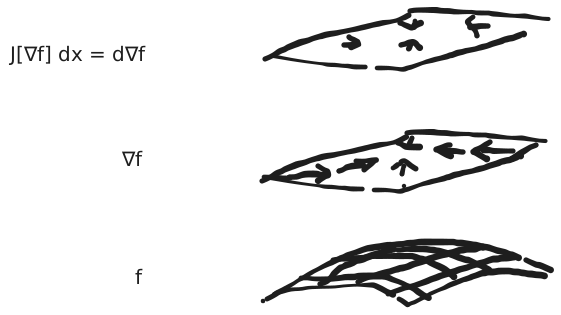
- Hessian matrix is the transpose of the Jacobian matrix of the gradient.
- \((\mathrm{d}\mathbf{x})^{\rm T}\mathbf{H}[f]\mathrm{d}\mathbf{x} = (\mathrm{d}\nabla f)^{\rm T}\mathrm{d}\mathbf{x}.\)
- If it is evaluated at a stationary point, then \(\mathrm{d}\nabla f\) would point in the direction of the gradient \(\nabla f\).
- Notice that \(\nabla f\) is the normal map, namely, a Gauss map.
- If the Hessian is positive-definite at \(\mathbf{x}\), then \(f\) attains an isolated local mimimum at \(\mathbf{x}\), by the same note, if the Hessian is negative-definite, then \(f\) attains an isolated local maximum.
7. Notations
7.1. Feynman Subscript Notation
Subscript determines which variable the operator act upon. For example, \[ \grad_{\mathbf{B}} (\mathbf{A}\vdot \mathbf{B}) = \mathbf{A} \cross (\curl{\mathbf{B}}) + (\mathbf{A} \vdot \grad) \mathbf{B}. \]
7.2. Hestenes Overdot Notation
The overdot denote the scope. \[ \dot{\grad} (\mathbf{A}\vdot \dot{\mathbf{B}}) = \mathbf{A} \cross (\curl{\mathbf{B}}) + (\mathbf{A} \vdot \grad) \mathbf{B}. \]
8. Identities
Split nabla into two parts \(\nabla = \mathbf{e}_i\partial^j\), apply the usual vector identitiees and differentiation identities:
- move scalar over the dot products
and reunite into nabla.
Dot Product \(\grad (\vb{A}\vdot \vb{B}) = (\vb{A}\vdot \grad)\vb{B} + (\vb{B}\vdot \grad) \vb{A} + \vb{A} \cross (\curl{\vb{B}}) + \vb{B} \cross (\curl{\vb{A}})\) The derivation becomes easy using the properties of Jacobian. Using the matrix calculus in denominator convention:
\begin{align*} \grad (\vb{A}\vdot \vb{B}) &= \pdv{\vb{A}^{\mathsf{T}}\vb{B}}{\vb{x}} \\ &= \pdv{\vb{A}}{\vb{x}} \vb{B} + \pdv{\vb{B}}{\vb{x}}\vb{A} \\ &= \vb{J}_{\vb{A}}^{\mathsf{T}}\vb{B} + \vb{J}_{\vb{B}}^{\mathsf{T}}\vb{A} \\ \end{align*}Rewrite each Jacobian as follows:
\begin{align*} \vb{J}_{\vb{A}}^{\mathsf{T}} \vb{B} &= \vb{J}_{\vb{A}}\vb{B} - (\vb{J}_{\vb{A}} - \vb{J}_{\vb{A}}^{\mathsf{T}})\vb{B} \\ &= (\grad^{\mathsf{T}}\vb{A}) \vb{B} - [\curl{\vb{A}}]_{\times} \vb{B} \\ &= (\vb{B} \vdot \grad) \vb{A} + \vb{B} \cross (\curl{\vb{A}}). \end{align*}Cross Product
- \[ \div(\vb{A} \cross \vb{B}) = (\curl{\vb{A}}) \vdot \vb{B} - \vb{A}\vdot (\curl{\vb{B}})\]
- Similar to the algebraic identity \(c \cdot (a \times b) = (c\times a) \cdot b\).
- \[\curl(\vb{A}\cross \vb{B}) = - (\div{\vb{A}})\vb{B} + (\vb{B} \vdot \grad)\vb{A} + (\div{\vb{B}})\vb{A} - (\vb{A}\vdot \grad)\vb{B} \]
From the identity \(\vb{J}_{\vb{A}\cross \vb{B}} = [\vb{A}]_{\times} \vb{J}_{\vb{B}} - [\vb{B}]_{\times}\vb{J}_{\vb{A}}}\), we can construct the curl:
\begin{align*} [\curl(\vb{A}\cross \vb{B})]_{\times} &= \vb{J}_{\vb{A}\cross \vb{B}} - \vb{J}_{\vb{A}\cross \vb{B}}^{\mathsf{T}} \\ &= [\vb{A}]_{\times} \vb{J}_{\vb{B}} - [\vb{B}]_{\times}\vb{J}_{\vb{A}} - (-\vb{J}_{\vb{B}}^{\mathsf{T}}[\vb{A}]_{\times} + \vb{J}_{\vb{A}}^{\mathsf{T}}[\vb{B}]_{\times}) \\ &= [(\tr \vb{J}_{\vb{B}})\vb{A} - \vb{J}_{\vb{B}}\vb{A}]_{\times} - [(\tr \vb{J}_{\vb{A}})\vb{B} - \vb{J}_{\vb{A}}\vb{B}]_{\times} \\ \end{align*}We are using identity that I don't quite understand: \[ [X]_{\times}M + M^{\mathsf{T}}[X]_{\times} = [(\tr M)X - MX]_{\times}. \]
Second Derivatives
- \[ \curl(\curl{\vb{A}}) = \grad(\div{\vb{A}}) - \laplacian{\vb{A}}\]
Using the second matrix expression of cross product and Jacobian:
\begin{align*} \curl(\curl{\vb{A}}) &= -\div{[\curl{\vb{A}}]_{\times}} \\ &= -\div(\vb{J}_{\vb{A}} - \vb{J}_{\vb{A}}^{\mathsf{T}}) \\ &= \div \vb{J}_{\vb{A}}^{\mathsf{T}} - \div\vb{J}_{\vb{A}} \\ &= \grad(\tr \vb{J}_{\vb{A}}) - \laplacian \vb{A} \\ &= \grad(\div{\vb{A}}) - \laplacian \vb{A} \end{align*}where the divergence of matrix is row-wise contraction.
9. Matrix Calculus
9.1. Notations
There exists two main notational convention in taking derivative with respect to a vector or a matrix: numerator layout convention and denominator layout convention. They have their own advantages and disadvantages, and some even mix and match them. It is generally recommended to follow the layout of the textbook presented.
The numerator layout treats the vector in the numerator as a column vector, and the vector in the denominator as a row vector. For example, \[ \frac{\partial \mathbf{y}}{\partial \mathbf{x}} = \begin{bmatrix} \frac{\partial y_1}{\partial x_1} & \frac{\partial y_1}{\partial x_2} & \cdots & \frac{\partial y_1}{\partial x_n} \\ \frac{\partial y_2}{\partial x_1} & \frac{\partial y_2}{\partial x_2} & \cdots & \frac{\partial y_2}{\partial x_n} \\ \vdots & \vdots &\ddots & \vdots \\ \frac{\partial y_n}{\partial x_1} & \frac{\partial y_n}{\partial x_2} & \cdots & \frac{\partial y_n}{\partial x_n} \\ \end{bmatrix}. \] which matches the layout of the standard Jacobian.
Similarly, the denominator layout treats the vector in the numerator as a row vector, and the vector in the numerator as a column vector. For example, \[ \frac{\partial f}{\partial \mathbf{x}} = \begin{bmatrix} \frac{\partial f}{\partial x_1} \\ \frac{\partial f}{\partial x_2} \\ \vdots \\ \frac{\partial f}{\partial x_n} \\ \end{bmatrix} \] which matches the layout of the standard gradient.
A matrix can be used in either the numerator or denominator, but not both. When a matrix in in the denominator, it is treated as the transpose of itself. In these matrix calculus notation, tensors whose ranks are higher than 2 is not the subject of interest.
This notation is just for convenience. See Matrix calculus - Wikipedia for more.
This document will employ the numerator layout.
9.2. Identities
Vector by Vector
- \[ \pdv{\mathbf{x}}{\mathbf{x}} = \mathbf{I} \]
- \[ \pdv{\mathbf{A}\mathbf{x}}{\mathbf{x}} = \mathbf{A} \] (\(\mathbf{A}\) is not a function of \(\mathbf{x}\))
Scalar by Vector
- \[ \pdv{\mathbf{u}^{\mathsf{T}} \mathbf{v}}{\mathbf{x}} = \mathbf{u}^{\mathsf{T}} \pdv{\mathbf{v}}{\mathbf{x}} + \mathbf{v}^{\mathbf{T}} \pdv{\mathbf{u}}{\mathbf{x}}\]
- \[ \pdv[2]{f}{\mathbf{x}^{\mathsf{T}}}{\mathbf{x}} = \mathbf{H} \] for Hessian maxtrix
- \[ \pdv{\mathbf{x}^{\mathsf{T}} \mathbf{A} \mathbf{x}}{\mathbf{x}} = \mathbf{x}^{\mathsf{T}} (\mathbf{A} + \mathbf{A}^{\mathsf{T}})\]
Vector by Scalar
- \[ \pdv{\mathbf{f}(\mathbf{u})}{x} = \pdv{\mathbf{f}(\mathbf{u})}{\mathbf{u}} \pdv{\mathbf{u}}{x}\]
Matrix by scalar
- \[ \frac{d}{dx}(\mathbf{A}\mathbf{B}) = \frac{d\mathbf{A}}{dx}\mathbf{B} + \mathbf{A}\frac{d\mathbf{B}}{dx} \]
- \[\frac{d\mathbf{A}^{-1}}{dx}=-\mathbf{A}^{-1}\frac{d\mathbf{A}}{dx}\mathbf{A}^{-1}\]
10. Exponential
\[ e^{\mathbf{A}} := \sum_{n=0}^\infty \frac{\mathbf{A}^n}{n!}. \]
10.1. Properties
- \( \mathbf{A}\mathbf{B} = \mathbf{B}\mathbf{A} \iff e^{\mathbf{A}}e^\mathbf{B} = e^{\mathbf{A}+\mathbf{B}} \)
- \( e^\mathbf{O} = \mathbf{I} \)
- \( \left(e^\mathbf{A}\right)^{-1} = e^{-\mathbf{A}} \)
- \( \left(e^\mathbf{A}\right)^n = e^{n\mathbf{A}} \)
- \( \left(e^{\mathbf{A}}\right)^{\mathrm T} = e^{\mathbf{A}^\mathrm{T}} \)
- \( \operatorname{det}\left(e^\mathbf{A}\right) = e^{\operatorname{tr}(\mathbf{A})} \)
- If \(\mathbf{A}\) is diagonalizable: \( e^{\mathbf{A}} = \mathbf{V}e^{\mathbf{\Lambda}}\mathbf{V}^{-1}. \)
- The solution to the differential equation: \( \mathbf{y}' = \mathbf{A}\mathbf{y} \) is the matrix exponential: \( e^{\mathbf{A}t}\mathbf{y}_0 \) for any square matrix \(\mathbf{A}\).
11. Jacobi's Formula
- Complementary to the Liouville's formula.
11.1. Formula
\[ \frac{d}{dt}\det \mathbf{A}(t) = \operatorname{tr}\left(\operatorname{adj}(\mathbf{A}(t))\frac{d\mathbf{A}(t)}{dt}\right) \] where \(\operatorname{adj}\) is the adjugate matrix.
If \(\mathbf{A}\) is invertible, it can further be said to be \[ \frac{d}{dt}\det\mathbf{A} = \det(\mathbf{A}(t)) \operatorname{tr}\left(\mathbf{A}^{-1}(t)\frac{d}{dt}\mathbf{A}(t)\right) \]
11.2. Derivation
Let us take derivative of the determinant with respect to each entry and use chain rule and Leibniz rule: \[ \dv{\det \vb{A}}{t} = \sum_{i,j} \pdv{\det \vb{A}}{A_{ij}} \dv{A_{ij}}{t}. \] The derivative with respect to each entry can be obtained from Laplace Expansion of determinant: \[ \frac{\partial \det\mathbf{A}}{\partial A_{ij}} = (\operatorname{adj}\mathbf{A})_{ji} = (\mathbf{C})_{ij}, \] where \(\mathbf{C}\) is the cofactor matrix;
The entrywise sum is equivalent to the Frobenius inner product, that accounts for the trace.
11.3. Corollary
\[ d\det(\mathbf{A}) = \operatorname{tr}(\operatorname{adj}(\mathbf{A})\,d\mathbf{A}) = \langle (\operatorname{adj}\mathbf{A})^{\rm T}, d\mathbf{A}\rangle_{\rm F}, \] where \(\langle \cdot,\cdot\rangle_{\mathrm{F}}\) is the Frobenius inner product;
\[ \nabla \operatorname{det}(\mathbf{A}) = (\operatorname{adj}\mathbf{A})^{\rm T} = \mathbf{C}, \] where \(\nabla\) is the gradient.